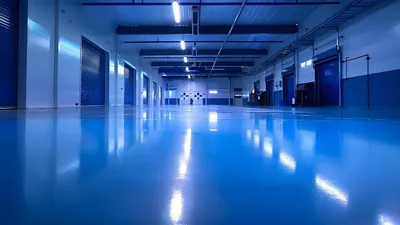
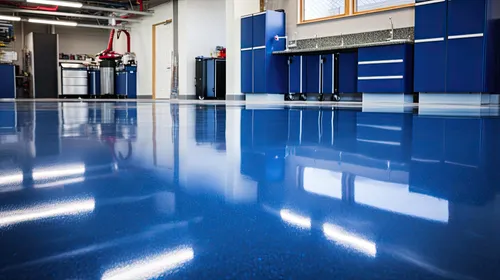
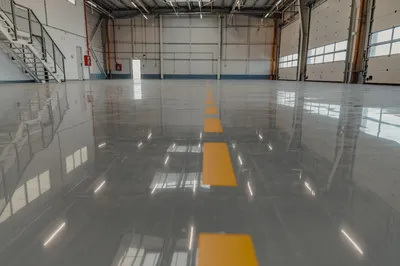
Factory and Light Manufacturing Floor Coatings in Warren Township, NJ
Light manufacturing, fabrication, and production facilities in Warren Township's Martinsville commercial zone need floor systems that hold up under the combined demands of manufacturing operations: machine base loads, forklift and pallet jack traffic, chemical exposure from cutting fluids and coolants, and the same valley floor vapor pressure that affects every commercial slab in the Martinsville section of the township. A factory floor failure is not just an aesthetic issue - a peeling or delaminating floor creates slip hazards, traps contamination, and produces a maintenance problem that compounds with every shift.
What We Evaluate for Factory Floor Coating
Every manufacturing environment has unique chemical, mechanical, and thermal demands. We assess these during your free site walk.
CNC machines, stamping presses, lathes, and assembly fixtures concentrate weight on legs and leveling pads. We calculate point-load pressure and select a system thickness and hardness that distributes force without cracking or denting. Thin coatings fail under static heavy loads.
Coolant, hydraulic fluid, cutting oil, solvents, and acids vary by operation. We identify what contacts your floor and match the chemistry. Epoxy resists most oils and mild acids. Aggressive solvents or concentrated acids may require novolac epoxy or urethane cement.
Welding sparks, heat-treat ovens, and hot parts placed on the slab create localized thermal stress. Standard epoxy softens above 140°F. We use systems rated for your actual thermal exposure and protect high-heat zones with appropriate materials.
Forklifts, AGVs, and tow motors create concentrated wear in travel lanes and turning areas. We build those zones thicker and apply harder topcoats. Line striping defines lanes and keeps equipment traffic predictable.
OSHA color standards for aisles, equipment zones, and hazard areas are common in manufacturing. We include line striping, color zones, and safety markings as part of the project. Layout is customized to your facility.
Manufacturing floor systems in Warren Township facilities
Manufacturing facilities in the Martinsville section of Warren Township deal with a floor condition set that makes standard light-commercial coating systems inadequate for the application. The valley floor subgrade in Martinsville generates vapor pressure under industrial concrete that accelerates coating failure under manufacturing loads. Machine bases create point loads that exceed standard epoxy tensile bond strength if the primer below is inadequately bonded to the concrete because of vapor pressure blistering. Forklift and pallet jack traffic in loading and staging areas creates cyclic wheel loads that delaminate at control joints if the joints are not properly filled and bridged before coating.
Chemical exposure in light manufacturing environments varies by operation type but commonly includes cutting fluids and coolants in machining operations, solvents in surface finishing and cleaning operations, hydraulic fluids from press and machinery systems, and in some operations, pH-aggressive cleaning chemicals used in parts washing. Many of these chemicals attack standard epoxy topcoats at the surface level - not immediately, but progressively over the operating life of the floor. Specifying a chemically-resistant topcoat matched to the specific chemical exposure of the facility is the approach that produces a floor with a full service life rather than one that needs to be replaced in five years.
We install manufacturing floor systems in Warren Township facilities around your production schedule. Most manufacturing operations cannot simply stop for three days while the floor is coated and cured. We work with your production manager to phase the installation by section, rotating through zones based on your production rotation and the cure window each section requires before equipment re-enters.
Every project follows the same proven steps, from free estimate to final walkthrough.
Your floor backed for life. In Writing. If the coating bond ever fails, peels, or delaminates, we come back and make it right: materials and labor, at no cost to you.
What you get
Key Benefits
- Moisture vapor emission testing on Martinsville valley floor manufacturing slabs before system specification
- High-build epoxy mortar for machine base zones and heavy load areas
- Chemical-resistant topcoat selection matched to the specific chemical exposure profile of your operation
- Control joint and crack fill as mandatory prep to prevent delamination under forklift and equipment loads
- Phased installation coordinated with your production schedule or maintenance window
- Written scope with slab assessment findings, system specification, and phased installation timeline
Ideal For
Light manufacturing, machining, fabrication, assembly, and production facilities in Warren Township's Martinsville commercial zone and throughout the Route 78 corridor. Especially relevant for facilities where an aging slab is showing coating failure under current operating loads, and for new operations moving into an existing Martinsville commercial building where the slab condition is unknown.
What to Expect
We visit and assess before quoting. Manufacturing floor installs are phased around your production schedule. Return-to-use times depend on the system and ambient temperature - we provide written zone-by-zone timelines. Heavily contaminated slabs may require extended prep, which we flag at the estimate stage.
Factory Floor Coating FAQ - Warren Township
Our Warren manufacturing floor is failing at the machine bases. The rest of the floor looks fine. What is causing that?
Machine base failures almost always trace to point load concentration exceeding the tensile bond strength of the coating at that location. Machine bases create static loads that are significantly higher per square inch than foot traffic or even forklift wheel contact. If the vapor primer under the coating was either not applied or was applied to a slab that tested above the primer's rated threshold, the bond at high-load contact points fails first - which is the machine base and leg locations. We assess the delamination pattern during the site visit to confirm the failure mode and build the replacement prep to address it.
Does Warren Township's terrain affect what we need for our Martinsville factory floor?
Yes. Martinsville sits in the lower valley section of Warren, where the soil profile generates vapor pressure under industrial slabs similar to the rest of the Somerset County industrial corridor. Manufacturing facilities in Martinsville commercial buildings built in the 1980s and 1990s commonly have inadequate vapor barriers, and the clay-adjacent subgrade keeps the slab hydrated from below year-round. Under machine base loads and forklift traffic, vapor pressure blistering happens faster than under foot traffic alone. Vapor emission testing before primer specification is required on every Martinsville manufacturing slab we assess.
Get a quote for your Warren manufacturing floor
We assess the slab, specify a system for your actual operating loads and chemical environment, and phase the install around your production schedule.
Call Us: (908) 916-3535