Restaurant Kitchen Floor Coatings in Warren Township, NJ
Restaurant and food service operations in Warren Township's commercial zones - along King George Road, in the Martinsville neighborhood, and at the Route 78 corridor - need kitchen floors that pass health department inspection and hold up through daily commercial kitchen conditions without surface breakdown. The combination of thermal cycling from steam cleaning and hot water, caustic kitchen degreasers, wet-floor slip hazard, and the aggressive cleaning protocols required by the Somerset County health inspector eliminates standard epoxy as a viable long-term option for commercial kitchen applications. We install urethane cement and chemically-resistant systems for Warren restaurant and food service floors.
What Kitchen Floors Demand
Commercial kitchens are the harshest indoor environment for flooring. We evaluate these factors during your free site visit.
Fryer oil, cooking grease, acidic marinades, and caustic degreasers attack coatings daily. Standard epoxy softens and fails. We use urethane cement or chemical-resistant epoxy mortar systems formulated for continuous food-service exposure.
Boiling water, steam cleaning, and hot grease hitting a cold slab create thermal shock that cracks standard coatings. Urethane cement systems handle temperature swings from below freezing to over 250°F without cracking or debonding.
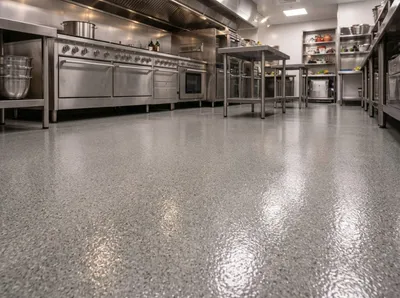
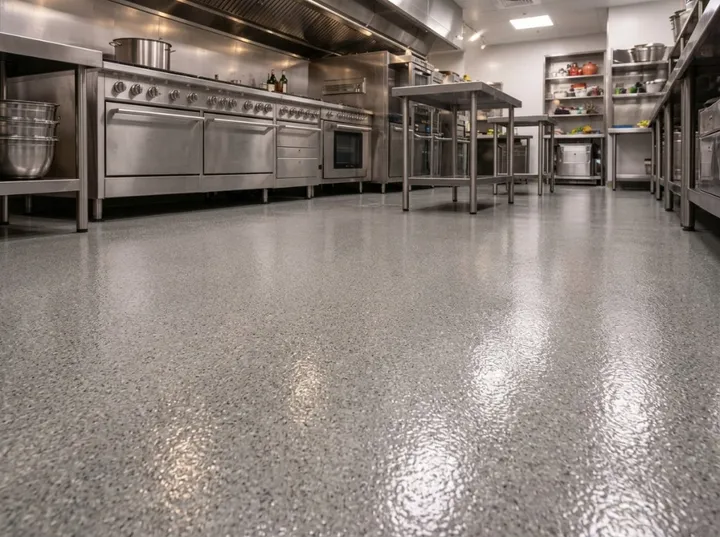
Kitchen floors are wet all day. We broadcast aluminum oxide or quartz aggregate into the coating for aggressive slip resistance that meets safety requirements. Texture level is matched to each zone -heavier in dish areas, moderate in prep zones.
Proper drainage prevents standing water. We install integral cove base where the floor meets the wall so there are no seams for food or water to collect. Slope-to-drain corrections can be built into the system when needed.
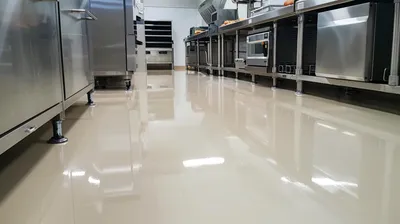
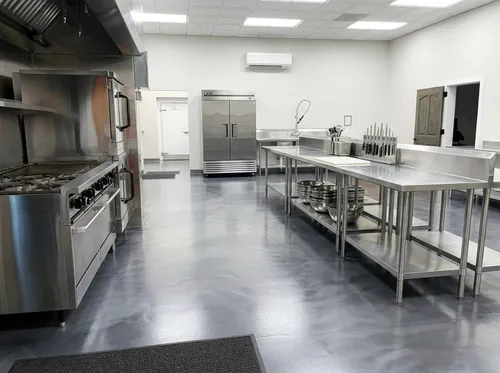
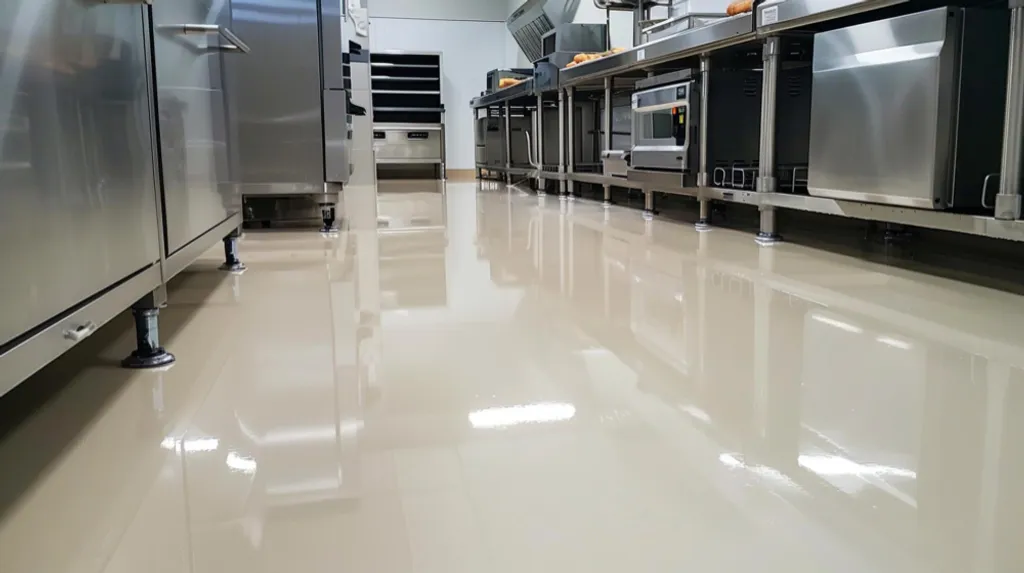
A seamless, non-porous floor with integral cove base and no grout lines meets the standard health departments expect. The surface can be power-washed and sanitized without degrading. We know what inspectors look for.
Commercial kitchen floors in Warren Township
Commercial kitchen floors fail for predictable reasons: the wrong system was installed initially, or a system that would be adequate in a lighter commercial application was used in a high-demand kitchen environment where it cannot hold up. Standard epoxy topcoats are the most commonly installed and most commonly failed product in this category. They look good initially and cost less than the alternatives, but they are not rated for the repeated thermal shock of steam cleaning, not rated for commercial degreasers at full working concentration applied repeatedly, and they become more porous as they degrade - which is the opposite of what a health inspector is looking for.
Urethane cement is the established specification for commercial kitchen floors in demanding applications because it handles the combination of conditions that standard epoxy does not. It is thermally stable across the temperature range that kitchen operations produce: from ambient temperature to steam cleaning and back, repeatedly, without cracking or delaminating at the substrate. It resists the full range of commercial cleaning chemicals used in kitchen sanitation at working concentrations. It is inherently slip-resistant from its aggregate texture, which means it meets the wet-surface safety requirements without a separate anti-slip additive. And it is repairable in place if a section is damaged, without requiring the whole floor to be stripped.
We install Warren Township restaurant kitchen floors overnight to keep the kitchen on its operating schedule. Most kitchen floor installations complete in two to three overnight sessions, with a clear return-to-service time for each zone. We work with your kitchen manager and the property owner to plan the install sequence around your prep and opening times, and we coordinate with the health inspector schedule for any new permit applications that require floor documentation.
Every project follows the same proven steps, from free estimate to final walkthrough.
Your floor backed for life. In Writing. If the coating bond ever fails, peels, or delaminates, we come back and make it right: materials and labor, at no cost to you.
What you get
Key Benefits
- Urethane cement floor system rated for commercial kitchen thermal cycling and chemical exposure
- Inherent slip resistance meeting wet-surface safety requirements without additional anti-slip additive
- Seamless, non-porous surface that satisfies Somerset County health department inspection requirements
- Overnight installation to keep your Warren restaurant on its operating schedule
- Coving at wall bases and around equipment bases to eliminate cleaning-access gaps
- Moisture vapor management under Route 78 Martinsville corridor slabs where required
- Written scope with system specification and zone-by-zone installation timeline
Ideal For
Restaurants, commercial kitchens, catering operations, and food service businesses in Warren Township's commercial zones including the Martinsville corridor and King George Road neighborhood commercial areas. Also relevant for any Warren food service operator replacing a failed epoxy kitchen floor or upgrading from quarry tile to a seamless system.
What to Expect
We assess the kitchen floor, test the slab, and install overnight around your operating schedule. Most Warren restaurant kitchen projects complete in two to three overnight sessions. Urethane cement requires a minimum cure time before hot water and chemical cleaning can resume - we provide the exact timeline based on the product system and ambient kitchen temperature.
Restaurant Kitchen Floor FAQ - Warren Township
Our Warren restaurant kitchen floor is peeling where the steam cleaner runs. Do we need urethane cement or can epoxy be repaired?
Steam cleaning is the most common cause of epoxy kitchen floor failure, and it is a system compatibility issue rather than an installation quality issue. Standard epoxy topcoats are not rated for the thermal shock of steam cleaning - the rapid temperature change from ambient to steam temperature and back causes interfacial separation between the coating and the substrate over time. Repairing the peeled sections with more epoxy produces the same failure in the same spots within months. The correct solution is to strip the failed epoxy and install a urethane cement system rated for thermal cycling, which is what the application actually requires.
Can you install the Warren kitchen floor without closing the restaurant?
Yes. We install overnight after service ends and before morning prep begins, and we phase the work to match your kitchen's layout. The back-of-house utility and prep areas typically come first, followed by the main cooking line and cold storage transition zones. Each section receives a written return-to-use time based on the urethane cement cure curve. For kitchens that operate seven days, we work through the schedule with your kitchen manager to find the optimal install sequence.
Does the Somerset County health department have specific requirements for commercial kitchen floors?
Yes. The health department requires non-porous, cleanable, and slip-resistant surfaces in commercial kitchen areas, and the surfaces must be maintained in a condition that prevents accumulation of food debris, grease, or moisture. A seamless urethane cement floor with covedwall base meets these requirements. Tile-grouted floors are increasingly difficult to pass because grout lines accumulate contamination that cannot be adequately cleaned. We can provide documentation of the system specifications used for any Warren food facility floor for health permit purposes.
Get a quote for your Warren restaurant kitchen floor
We assess the kitchen floor, design a system for the thermal and chemical demands of commercial kitchen operation, and install overnight around your schedule. Health department compliant systems for Warren food service operations.
Call Us: (908) 916-3535