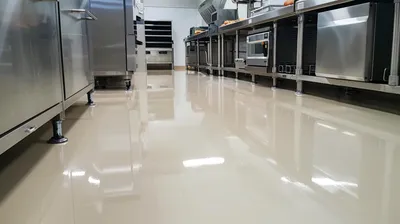
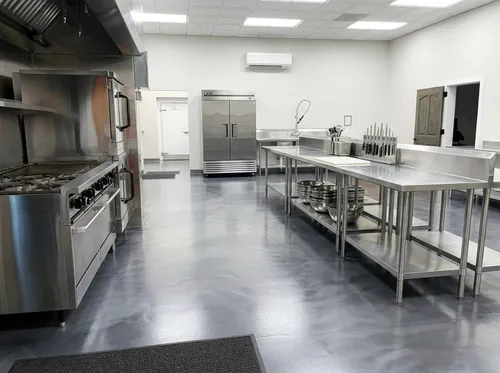
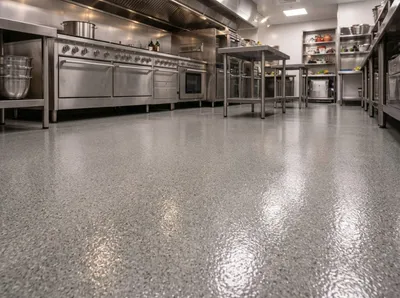
Restaurant and Kitchen Epoxy Floors in Princeton, NJ
Nassau Street's restaurant corridor runs through some of the oldest commercial kitchen spaces in Mercer County. Concrete under decades of quarry tile, grease, and failed drain systems. Coatings that were applied in one era and have been cleaning-chemical damaged in another. We install food-grade kitchen floor systems that hold up to daily cleaning, heavy equipment, and health department scrutiny.
What Princeton Restaurant Kitchens Require Before Coating
Commercial kitchen floors have failure modes that are different from any other environment. Here is what we address.
Old kitchen slabs absorb cooking grease down into the pore structure. Standard etching does not remove it. We use degreasing agents and in some cases apply heat before grinding to break down oil contamination and allow proper bonding.
Removing quarry tile often leaves thin-set and adhesive that must be fully ground out. We assess the depth of old material and quote realistic removal scope.
Commercial kitchens experience extreme temperature swings. We use urethane cement systems where temperatures will cycle between walk-in cold and steam-cleaning or dishwasher runoff.
Kitchen floors must slope to drain for sanitation and safety. We assess existing slope and discuss options if the current concrete does not drain adequately.
NJ health department standards require specific slip resistance in wet kitchen areas. We use systems with tested slip coefficients and add anti-slip aggregate in high-hazard zones.
Commercial Kitchen Floors on Nassau Street and in Princeton
A lot of the restaurant kitchen concrete on Nassau Street was originally finished with quarry tile, which is now being removed because the grout has failed and the tile is a slip and sanitation hazard. What is underneath is often concrete that has absorbed grease and cleaning chemicals for decades, is stained to the core, and has settled unevenly because the original base was built for a different building use. This is prep work that requires experience, not just a grinder and some epoxy.
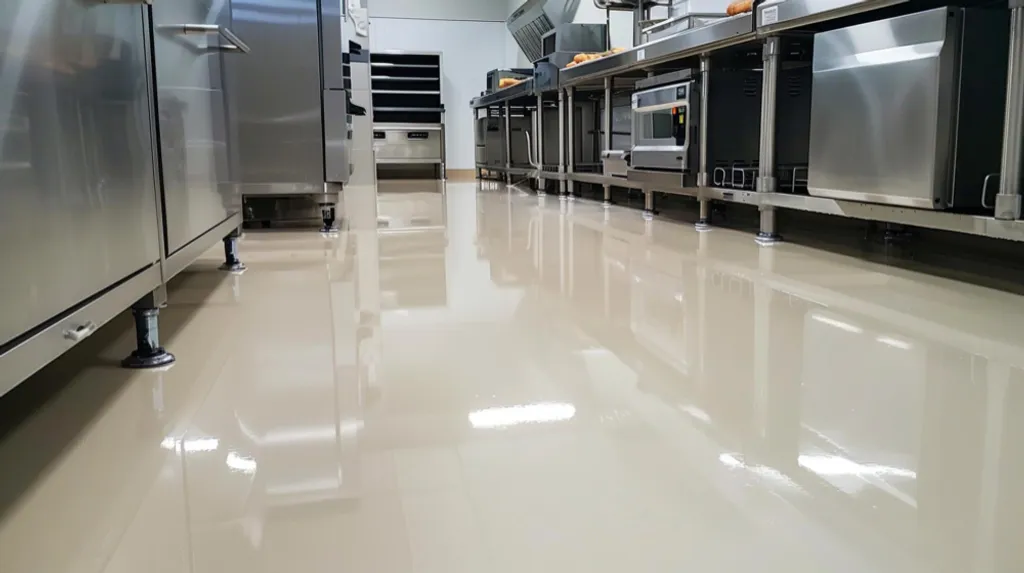
We use urethane cement systems for Princeton restaurant kitchens when the environment calls for it. Urethane cement handles the thermal shock of commercial kitchens, where boiling water, steam cleaning, and walk-in condensation create temperature swings that crack rigid coatings. It is also resistant to the alkaline and acidic cleaners used in food service, and it bonds directly to contaminated concrete without failing the way standard epoxy would.
For university dining halls, catering prep kitchens, and commercial kitchens that run on academic schedules, we coordinate installation during academic breaks and low-volume periods so the kitchen is ready when service resumes. We have done this on Princeton-area university dining facilities and understand what those timelines require.
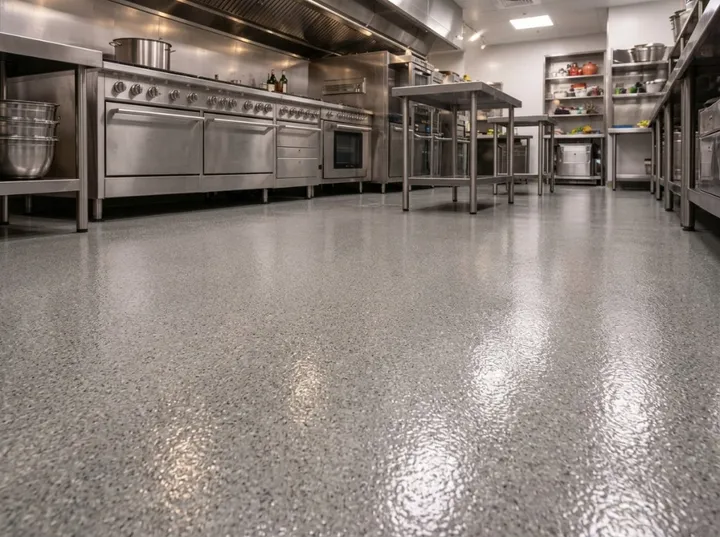
Every project follows the same proven steps, from free estimate to final walkthrough.
Your floor backed for life. In Writing. If the coating bond ever fails, peels, or delaminates, we come back and make it right: materials and labor, at no cost to you.
What Princeton Restaurants Get With a Proper Kitchen Floor
Key Benefits
- Urethane cement systems rated for thermal shock in commercial kitchens
- Grease-contaminated concrete properly degreased before bonding
- Seamless, grout-free surface with no bacteria harbor points
- Slip-resistant finish that meets NJ health department standards
- Installation coordinated around your service schedule or academic break
Ideal For
Princeton restaurants, cafes, and institutional kitchens on Nassau Street, in Forrestal Village, and in university dining facilities that need a durable, sanitary floor that passes health department inspection.
What to Expect
We visit, assess the concrete condition and drain layout, and provide a written scope. Kitchen floor installations are typically done during a 2 to 3 day overnight window. The floor is ready for light cleaning by morning.
Princeton Restaurant Kitchen Floor FAQ
Can you coat a kitchen floor that has been soaked in grease for years?
Yes, but we have to address the grease contamination first. We use industrial degreasers and grind aggressively to get to clean, porous concrete. Skipping this step is why many kitchen coatings fail within a year.
What is urethane cement and why do you use it in restaurant kitchens?
Urethane cement is a hybrid system that combines cement's hardness with urethane's flexibility and chemical resistance. It handles temperature swings that crack standard epoxy, bonds well to slightly contaminated concrete, and resists the cleaning chemicals used in food service.
Can you work around our restaurant's service schedule?
Yes. We typically work overnight or on days the kitchen is closed. We coordinate the timeline so the floor is ready for service before your next opening.
Does the floor need to slope to drain? Can you fix that?
Kitchens do need slope to drain. If the existing concrete does not drain properly, we discuss options including a self-leveling underlayment with built-in slope before the final coating system.
Will the new floor pass a health department inspection?
Yes. Our kitchen systems are seamless, non-porous, slip-resistant, and easy to sanitize. We discuss any specific local health department requirements during the estimate.
How long does a restaurant kitchen floor coating last?
Urethane cement systems in properly prepared kitchen environments last 10 to 20 years with routine maintenance. The aggressiveness of cleaning chemicals and thermal cycling are the main variables.
Get a quote for your Princeton kitchen floor
Tell us about your kitchen layout, schedule constraints, and we will assess the slab and give you a clear written quote.
Call Us: (908) 916-3535