Factory Floor Coatings in Branchburg, NJ
Light manufacturing and fabrication operations in Branchburg's Route 22 and Route 202 industrial zones need floor systems that match the real demands of the production environment, not residential or office-grade products applied to industrial slabs. Whether the operation involves mechanical fabrication, assembly lines, light processing, or mixed-use production and distribution, the floor has to handle forklift traffic, point-load impact from machinery, and the clay-soil vapor conditions that characterize every slab in the township.
What We Evaluate for Factory Floor Coating
Every manufacturing environment has unique chemical, mechanical, and thermal demands. We assess these during your free site walk.
CNC machines, stamping presses, lathes, and assembly fixtures concentrate weight on legs and leveling pads. We calculate point-load pressure and select a system thickness and hardness that distributes force without cracking or denting. Thin coatings fail under static heavy loads.
Coolant, hydraulic fluid, cutting oil, solvents, and acids vary by operation. We identify what contacts your floor and match the chemistry. Epoxy resists most oils and mild acids. Aggressive solvents or concentrated acids may require novolac epoxy or urethane cement.
Welding sparks, heat-treat ovens, and hot parts placed on the slab create localized thermal stress. Standard epoxy softens above 140°F. We use systems rated for your actual thermal exposure and protect high-heat zones with appropriate materials.
Forklifts, AGVs, and tow motors create concentrated wear in travel lanes and turning areas. We build those zones thicker and apply harder topcoats. Line striping defines lanes and keeps equipment traffic predictable.
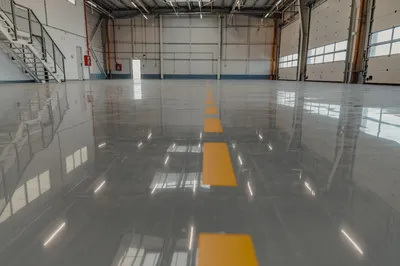
OSHA color standards for aisles, equipment zones, and hazard areas are common in manufacturing. We include line striping, color zones, and safety markings as part of the project. Layout is customized to your facility.
Manufacturing floor systems in Branchburg
Manufacturing and light industrial facilities in Branchburg's commercial zones typically occupy buildings that were purpose-built or converted in the 1980s and 1990s. The original concrete floors were adequate for the initial use but have accumulated wear from decades of forklift traffic, machinery vibration, chemical exposure, and cleaning. Floors that were never coated show surface erosion, joint failure, and scattered crack patterns. Floors that were coated with inadequate systems show delamination at high-stress zones.
The clay-heavy subgrade under these industrial buildings presents the same vapor challenge as residential slabs - but industrial loads accelerate the consequences. A coating on a factory floor that blisters from vapor pressure under foot traffic is annoying. The same blister under forklift wheel load fails rapidly because the cyclic stress peels the lifted coating away from the joint in both directions with every pass. We test industrial factory slabs for vapor emission before any system is specified, and vapor mitigation at the primer stage is standard, not optional, on Branchburg clay subgrade.
Our factory floor installations are phased around your production schedule. We assess traffic patterns, load zones, machinery positions, and production flow during the site visit and design the installation sequence to minimize the time any production zone is out of service. Written zone-by-zone return-to-use times are part of every factory floor scope.
Every project follows the same proven steps, from free estimate to final walkthrough.
Your floor backed for life. In Writing. If the coating bond ever fails, peels, or delaminates, we come back and make it right: materials and labor, at no cost to you.
What you get
Key Benefits
- Moisture vapor emission testing on every factory slab before system specification
- Epoxy mortar or high-build broadcast systems for forklift and machinery load zones
- Chemical degreasing for contaminated concrete in processing and maintenance areas
- Joint and crack repair as a mandatory step to prevent edge delamination under traffic
- Phased installation coordinated with your production schedule
- Written zone-by-zone return-to-production timeline before work begins
Ideal For
Light manufacturing, fabrication, assembly, and processing facilities in Branchburg's Route 22 and Route 202 industrial zones where aging concrete floors need a system upgrade appropriate for the production environment and the clay-soil slab conditions of the township.
What to Expect
We visit the facility, assess the slab and document load zones and traffic patterns, test for vapor emission and chemical contamination, and build a phased installation plan. Most factory sections return to production use within 48 to 72 hours of coating depending on the system and ambient temperature.
Factory Floor Coating FAQ - Branchburg
What system do you recommend for a light manufacturing floor in Branchburg?
For most light manufacturing environments in Branchburg, we specify a high-build broadcast epoxy system as the standard floor with an epoxy mortar build-up in defined high-load zones - under machinery pads, at loading dock aprons, and along primary forklift paths. The broadcast system provides traction and hides surface variation; the mortar build-up provides the thickness and bond strength needed under concentrated loads.
How long does a factory floor project take?
Project length depends on square footage, phasing requirements, and slab conditions. A single-phase installation on a 5,000 square foot factory floor takes two to three days. A phased installation that keeps production running takes longer overall but does not require a full production shutdown. We provide a detailed timeline during the estimate so you can plan around it.
Can factory concrete with machine oil contamination be successfully coated?
Yes, but the decontamination has to be thorough. We use penetrating alkaline degreaser, allow adequate dwell time, grind the contaminated layer, and retest the surface before priming. For floors that have been in continuous production without coating for many years, the contamination depth may require multiple degreasing and grinding cycles. We identify this during the assessment and include it in the prep scope.
Get a quote for your Branchburg factory floor
We assess the facility, test for vapor and contamination, and design an installation phased around your production schedule.
Call Us: (908) 916-3535